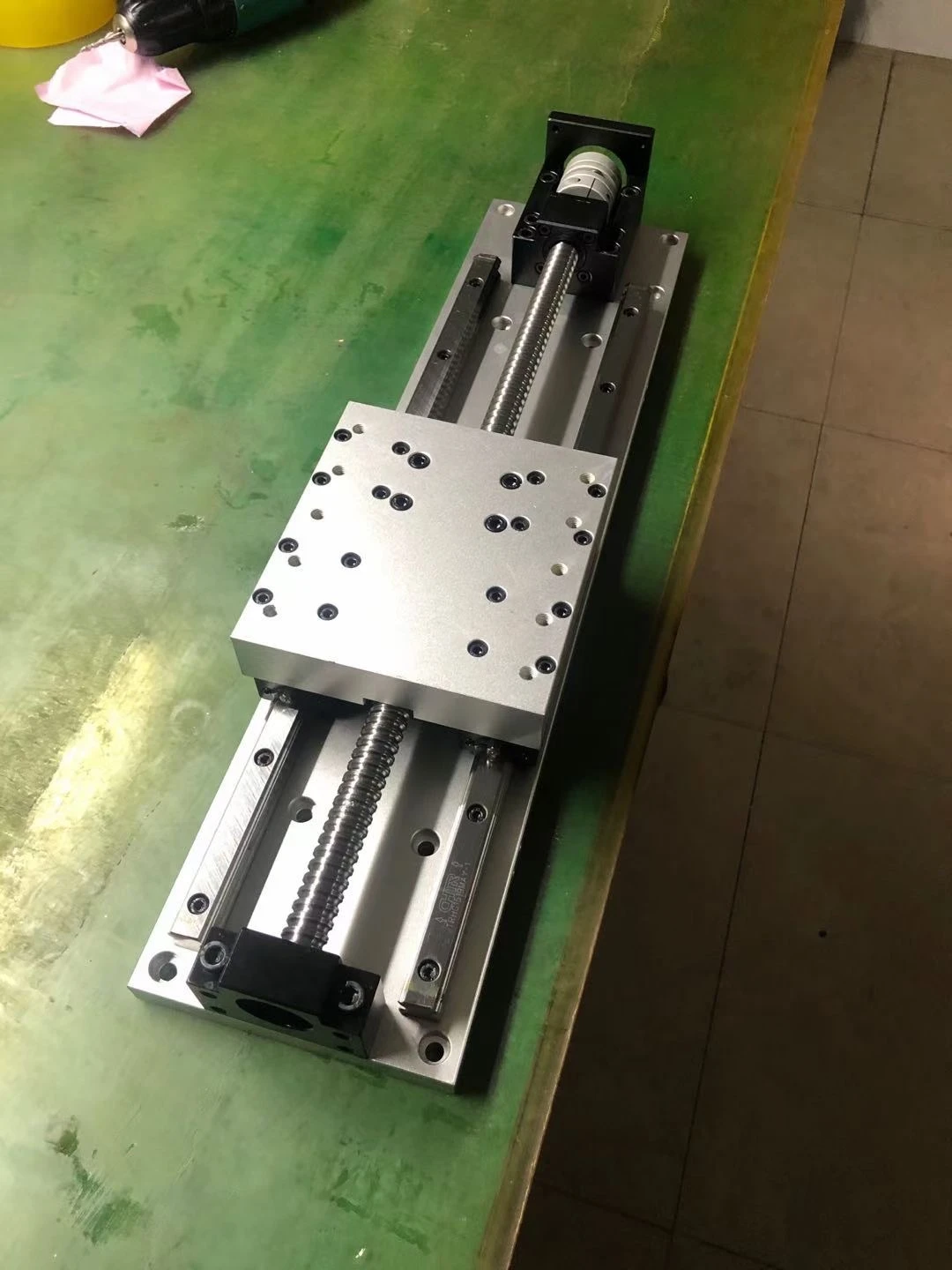
We took this photo before the HGHS210F was covered for packing. The Ball Screw sits down the middle of the base, with one rail on each side and the wide carriage plate already in place. This unit is going to Poland by sea for a machine-building project.
On the HGHS210F, the Ball Screw handles the drive while the two rails carry the carriage from both sides. Working stroke on this model runs from 100 mm to 1600 mm. That gives a machine builder quite a bit of room when the same basic CNC Linear Stage has to be used on different machine sizes.
The large top plate is useful when the customer still has tooling, a fixture or another mechanism to mount above the axis. There are several mounting positions on the plate rather than one fixed hole pattern. The screw and rails are also left open, so they are easy to reach while the machine is being assembled. On equipment where chips or dust are present, the customer normally has to take that open layout into account when adding guards or covers.
Poland has a sizeable machinery industry, and a 2025 sector report notes growing interest in automation and robotics as more factories invest in new technology. That is the sort of work where a CNC Linear Stage often turns up: a new machine axis, a transfer station, or a positioning section being added to an existing line.
Before the wooden case is closed, the carriage is kept from running back and forth along the base. The finished unit then goes with our other export cargo by sea to Poland.
HGHS210F orders do not all leave the workshop in exactly the same form. Stroke, motor interface and mounting details can be discussed before production. If the standard CNC Linear Stage layout does not fit the machine, we can also work from the customer's drawing.