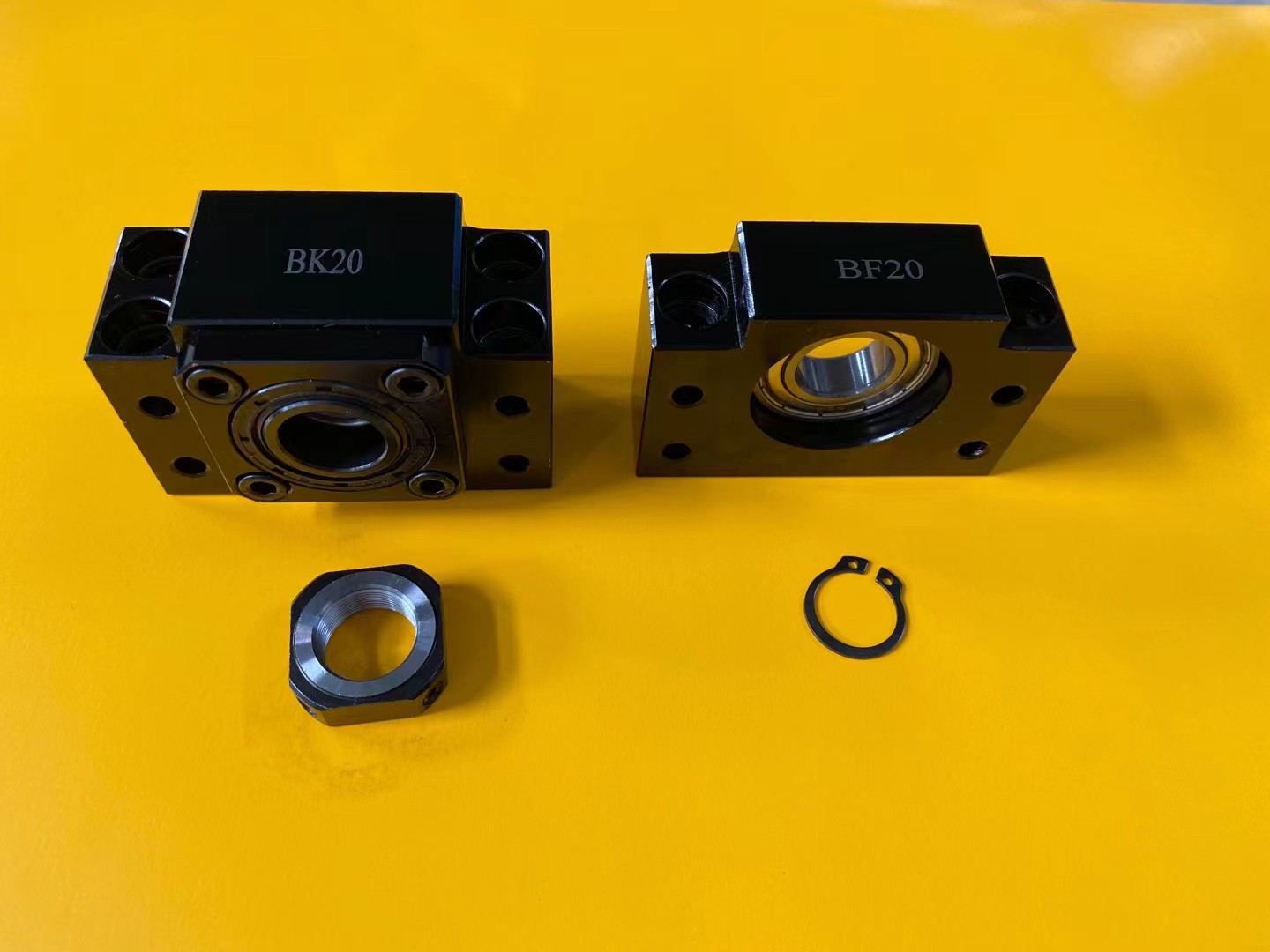
As the core support component within the transmission system, the load balance of the ball screw support bracket is crucial for stable equipment operation. Uneven loading can lead to issues such as vibration, noise, and structural damage. Therefore, learning how to assess whether the support bracket's load is balanced is essential. Below are several methods for determining the load balance of a ball screw support bracket.
Observe vibration and noise levels during operation: - If the support mount exhibits no noticeable vibration, consistent noise levels without sharp, abnormal sounds, this indicates stable ball load distribution and no eccentric loading on the mount body, suggesting a high probability of balanced forces. - Persistent vibration, fluctuating noise levels, or metallic grinding noises may indicate unbalanced forces causing bearing misalignment or mount deformation.
Monitoring bearing temperature variations: Under normal load-balanced conditions, the operating temperature of bearings within a support housing will stabilise within a reasonable range (typically ≤60°C), with minimal temperature differential between the fixed and support ends (≤5°C). Should the temperature at either bearing end rise rapidly, exceed 70°C, or exhibit excessive temperature differential between ends, this may indicate load imbalance issues such as uneven axial force distribution or improper bearing preload.
Inspect the smoothness of ball screw movement: Manually or via equipment programming, drive the screw in reciprocating motion. Should movement exhibit uniform resistance without stuttering or abrupt jerks, this indicates stable support and balanced loading from the ball screw support bracket. Should resistance fluctuate erratically, stuttering occur, or backlash abnormally increase, this may indicate misalignment of the support bracket causing deviation in the screw's coaxiality.
Observe the fit between the bracket body and mounting surface: After shutdown, inspect the contact between the support bracket and the machine frame mounting surface. If the bracket body shows no warping, mounting bolts are secure, and the contact surface exhibits no localised wear or indentations, this indicates uniform force distribution. Should warping of the bracket body, localised indentations on the mounting surface, or loose bolts occur, this likely indicates uneven force distribution causing localised stress concentration.
Inspect bearing wear and damage: After dismantling the ball screw support bracket, observe the bearing condition. Should the bearing balls and raceways exhibit no uneven wear, pitting, or spalling, with the cage intact, this indicates balanced loading. Should severe unilateral wear be present, irregular scratches appear on the raceway, or ball damage occurs, this likely stems from prolonged unbalanced loading causing eccentric wear.
In summary, by observing vibration and noise levels, monitoring bearing temperatures, and assessing the smoothness of ball screw movement, one can rapidly determine whether the support system is functioning correctly. Regular inspections and dynamic levelling effectively extend equipment lifespan while enhancing machining precision and production efficiency.