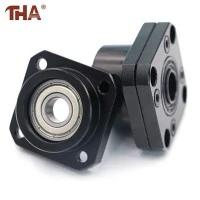
When a precision CNC gantry or an optical measuring slide starts showing micro-vibrations at high feed rates, technicians often suspect the ball screw or the linear rail. Yet, when dial indicators trace a tiny wobble right at the shaft end, the real culprit is usually the bearing support block. Miniature support units (such as the FK6, FK8, or BK10 micro series) anchor the unsupported ends of fine feed screws. If those bearing blocks are bolted down with internal angular contact bearings misaligned, the shaft will whip, the internal preload will crush the raceways, and the entire axis will lose its sub-micron positioning crispness.
Engineering Analysis: Fixed-End vs. Supported-End Bearing Layouts
Compact motion systems require distinct mechanical roles for each end of the drive shaft. The fixed side (typically designated with an FK or BK prefix) bears both axial thrust and radial loads, housing a matched pair of preloaded 60-degree contact bearings. The opposite floating side uses a simple single deep-groove ball bearing that slides axially inside its housing to accommodate thermal expansion. When machines run continuously, the steel screw shaft gets hot and grows in length. If a technician mistakenly locks both ends with rigid double-bearing blocks, the expanding shaft has nowhere to go. That trapped thermal growth bows the screw, side-loads the motor, and quickly destroys the miniature support bearings.
Field Troubleshooting & Assembly Protocol
Check Housing Squareness: Never force a support bracket down onto an un-machined aluminum mounting face. Shim the base if necessary to keep the bearing bore dead-square with the screw shaft centerline.
Lock the Lock-Nut Correctly: When tightening the round bearing lock-nut onto the screw thread, use a spanner wrench while holding the inner ring. Over-tightening deforms the precision bearing spacers and induces heavy drag before the motor even turns.
Inspect Grease Packed Internals: High-viscosity greases cause rolling friction and heat buildup in small 6 mm or 8 mm bores. Pack the bearing cavity lightly with a clean synthetic grease rated for high-speed micro-bearings.
Field Integration FAQ
Why does a miniature support bearing develop a rough grinding feel after a few weeks of use?
A rough or gritty feel usually points to excessive preload from the lock-nut or a slight angular misalignment between the fixed block and the floating bearing. That pinches the rolling elements, causing premature brinelling of the raceways.
What is the functional difference between FK and BK series support units?
FK units use a round mounting flange designed for face-mounting directly against machined end walls of a machine bed. BK units feature a square block body with base mounting holes, allowing you to bolt the support down vertically onto flat table surfaces.
How do you prevent bearing failure caused by thermal elongation on long lead screws?
Always leave the opposite end of the screw supported by a floating bearing block (like FF or EF series) with enough internal clearance to let the shaft slide back and forth as it heats up and cools down during operating cycles.
Technical Performance Matrix
| Parameter | Engineering Specification |
| Unit Series Options | FK (Round Flange) & BK (Square Base) Miniature Support Units |
| Bore Size Range | Micro Metrics: 6 mm, 8 mm, 10 mm, 12 mm Shaft Diameters |
| Bearing Configuration | Matched Pair P5-Grade Angular Contact Bearings (Fixed End) |
| Material Composition | S55C Carbon Steel / High-Grade Alloy Steel Housing Bodies |
| Surface Finish | Black Oxide Chemical Protective Coating for Corrosion Resistance |
| Locking Mechanism | Precision Lock-Nut and Set Screw Secure Retention System |