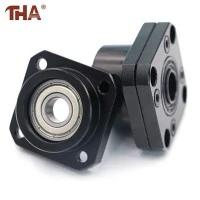
When a desktop CNC router or a micro-dispensing gantry starts losing steps halfway through a program, most operators immediately check current limits on the stepper driver. Yet, when the motor shaft feels blisteringly hot and the axis screeches near the end of travel, the root cause is almost always mechanical binding. Precision miniature ball screws operate with tight internal tolerances. If the motor bell housing is bolted down even a fraction of a millimeter out of square, the tiny journal bends, the gothic-arch raceway pinches the steel balls, and the entire drive locks up cold.
Engineering Analysis: Direct-Coupled vs. Floating Lead Screw Architectures
Miniature motion stages typically rely on small-diameter precision screws (such as 8 mm or 10 mm diameters with 2 mm or 4 mm leads) driven directly by NEMA 17 or NEMA 23 stepper motors. Unlike large industrial axes that use independent floating support blocks, many compact micro-slides depend entirely on the motor's front bearing to locate one end of the screw shaft. When heat builds up during high-speed continuous runs, the steel shaft expands axially. Without a floating journal or a spring-loaded coupling to absorb that thermal growth, the screw bows outward. That sideways deflection forces the miniature nut against the aluminum carriage floor, destroying the internal recirculating tubes and creating catastrophic drag.
Field Troubleshooting & Assembly Protocol
Check Motor-to-Shaft Concentricity: Never use rigid solid sleeves to mate a stepper motor to a miniature ball screw. Always deploy a zero-backlash flexible disk coupling or a jaw coupling with an elastomer spider to absorb minor angular and parallel misalignments.
Align Before Final Torque: Loosening the motor faceplate bolts and manually spinning the screw from end to end lets the assembly find its natural center. Snug the mounting screws in a diagonal pattern only after the carriage glides smoothly past the midpoint with zero fingertip resistance.
Control Lubrication Viscosity: Heavy industrial greases will cause hydraulic lock inside micro-nut returns. Use low-viscosity synthetic oils or specialized cleanroom lubricants to keep drag low and prevent the tiny steel balls from skidding.
Field Integration FAQ
Why does a miniature ball screw bind up only when the machine runs at high speeds?
High-speed continuous running generates frictional heat that elongates the steel screw shaft. If both ends are rigidly locked without expansion clearance, the shaft buckles sideways, creating massive radial side-loads on the ball nut and causing motor stalls.
How do you match ball screw lead to your motor torque on vertical vs horizontal axes?
Fine pitch leads (1 mm or 2 mm) increase positional resolution and prevent Z-axis back-driving under gravity when power drops. Switching to 4 mm or 5 mm leads pushes higher linear velocity, but you need a larger NEMA motor to supply the torque needed for fast acceleration and spinning higher rotational inertia.
What causes a miniature ball nut to develop sudden internal clicking sounds?
Sudden clicking or popping usually means a recirculating circuit has picked up debris or a stray steel ball has jammed across the return bridge. Flushing the nut immediately with contact cleaner or lightweight solvent can clear the path before the raceway gets deeply scored.
Technical Performance Matrix
| Parameter | Engineering Specification |
| Screw Diameters | Miniature Metric Sizes: 6 mm, 8 mm, 10 mm Nominal Outer Diameters |
| Standard Lead Options | 1 mm, 2 mm, 4 mm, 5 mm Precision Right-Hand Lead Pitches |
| Accuracy Grades | JIS C5 Ground Precision or C7 Rolled Economy Feed Screws |
| Material Composition | GCr15 / SAE 52100 High-Carbon Chromium Bearing Steel |
| Surface Treatment | Induction Hardened Raceways (HRC 58-62) with Optional Anti-Corrosion Coating |
| Thrust Configuration | Direct Motor Mount or Matched Miniature Fixed-End Bearing Support |