

In modern mechanical engineering and automation equipment, linear guide rail is the key component to realize high-precision linear motion. Whether in CNC machine tools, automated production lines, medical equipment and precision instruments, linear guides play an irreplaceable role. This paper will introduce the dimension parameters of linear guide rail and its importance in detail to help you better understand and choose the appropriate linear guide rail.

Basic dimensional parameters of linear guide rail.
1. Width of guide rail (W): the width of guide rail is a key parameter to determine its bearing capacity and stability. The larger the width, the stronger the bearing capacity and the higher the stability of the guide rail. Common guide rail widths are 15 mm, 20 mm, 25 mm, 30 mm, 35 mm and other specifications.
2. Guide rail height (H): the guide rail height is an important parameter that affects the installation space and rigidity. The guide rail with higher height has better bending rigidity, which is suitable for occasions requiring high rigidity and precision.
3. Slider length (L): the length of the slider directly affects the load distribution and service life of the guide rail. Generally speaking, the longer the slider length, the more uniform the load distribution and the longer the service life.
4. Slider width (B): Slider width is another important parameter that affects the bearing capacity and stability of the guide rail. The slider with a larger width can provide a larger contact area and improve the bearing capacity and stability of the guide rail.
5. Installation hole spacing (P): the installation hole spacing is the center distance between the installation holes of the guide rail. Reasonable installation hole spacing can ensure the installation accuracy and stability of the guide rail.
6. Slider height (H1): Slider height affects the overall installation height and motion stability of the guide rail. The slider with moderate height can ensure the stability and smoothness of the guide rail during the movement.
7. Size of mounting hole of slider (D1, D2): the size of mounting hole on slider refers to the diameter and depth of bolt hole used for fixing the slider. Accurate mounting hole size can ensure the firm connection between the slider and the equipment, and ensure the accuracy and stability of the movement.
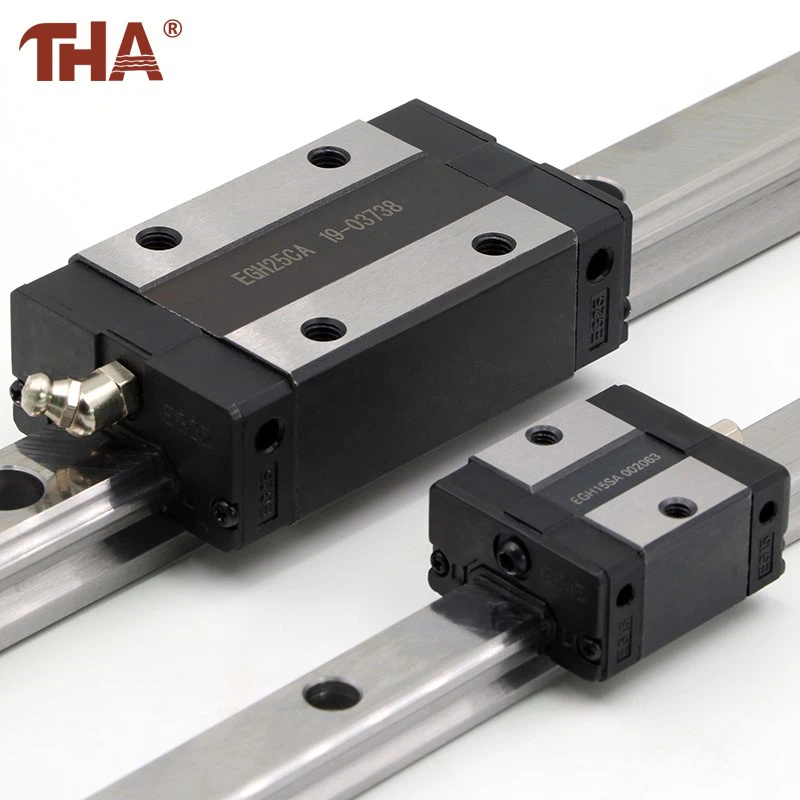
How to choose a suitable linear guide rail size.
1. Determine the load requirements: according to the load requirements of the equipment, select the width of the guide rail and the size of the slider suitable for the bearing capacity to ensure that the guide rail can bear the working load stably.
2. Considering the installation space: according to the installation space of the equipment, choose the appropriate height of the guide rail and the size of the slider to ensure that the guide rail can be installed smoothly and is not limited by space during operation.
3. Pay attention to accuracy requirements: for equipment with high accuracy requirements, guide rails and sliders with high dimensional accuracy and small error should be selected to ensure the operation accuracy of the equipment.
4. Evaluation of service environment: considering the service environment of the equipment, select suitable materials and surface treatments of the guide rail and slider, such as anti-corrosion treatment, to ensure the stable operation of the guide rail in various environments.
The dimension parameters of the linear guide rail are very important in its application, which directly affects its bearing capacity, motion accuracy and service life. By understanding and selecting the appropriate linear guide rail size parameters, the efficient operation and long-term use of the equipment can be ensured. Whether in industrial automation, precision machinery, or other high-precision applications, choosing the appropriate linear guide rail size is the key to ensuring the performance of equipment.
Whatsapp/wechat:17769815516/17769816967
Email:admin@gyballscrew.com
gykristyliu@gmail.com
sales@gyballscrew.com


