


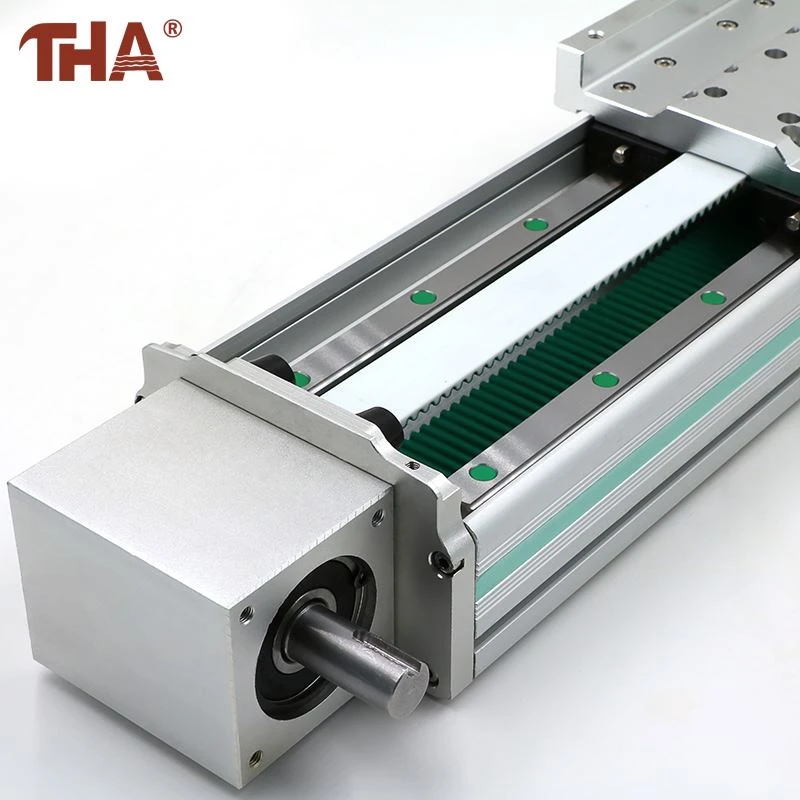
The module in the middle of the workbench already has its belt and carriage in place. Beside it are several long aluminum profiles with the guide shafts exposed. There is still room to work around the end pulley, which would be much harder to reach once the module is installed inside a machine.
Belt tension is worth checking on a unit of this length. If the belt is too loose, the carriage may respond poorly when changing direction. Pulling it too tight puts extra pressure on the pulley bearings. We also need to check how the carriage runs along the two round shafts, particularly towards the ends of its travel.
A Belt Drive Linear Stage can be used to move trays between workstations. This is a useful application in northern Vietnam, where much of the electronics manufacturing around Bac Ninh and Hai Phong involves electronic components, displays and consumer devices. On a tray-handling machine, the distance between two working positions may be over a metre. The carriage makes the same trip back and forth throughout the working day.
For these longer movements, customers often consider a belt drive linear stage instead of a screw-driven unit. Our catalogue includes belt-driven modules with working strokes from 300 mm to 2500 mm. When quoting a custom length, we ask for the actual distance the carriage needs to travel. The motor and pulley housings take up some of the space at either end.
The planned destination for these modules is Vietnam, by sea. Packing a long aluminum profile requires a little more attention to the middle section of the wooden case. Supporting the module at the ends alone leaves too much of its length unsupported.


