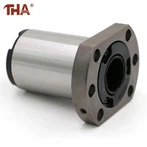
The use of the ball screw is very large. It can convert rotary motion into linear motion or exchange the direction of motion. It is a common transmission device in industrial equipment. Ball screw is a common name that has the characteristics of high precision, good transmission efficiency and high axial stiffness, so it is mainly widely used in various industrial equipment, machine tools, and precision instruments. It can be said that it promotes our industrial production. The following will introduce how to select the ball screw for everyone. If you are interested, please read it together!
Ball screw
1. Known conditions: UPH, worktable mass m1, stroke length ls, maximum speed Vmax, acceleration and deceleration time t1 and t3, positioning accuracy +-0.3mm/1000mm, reciprocating motion cycle, clearance 0.15mm
2. Selection items: screw diameter, lead, nut type, accuracy, axial clearance, screw support, motor
3. Calculation:
1. Precision and type.
(clearance, axial clearance) 0.15mm, select the lead screw with the clearance below 0.15, check the table to select the lead screw with the diameter below 32mm. 32mm clearance is 0.14mm.
In order to satisfy +-0.3mm/1000mm, +-0.3mm/1000=x/300
Then x=+-0.09mm. The lead accuracy of ± 0.090mm / 300mm or more must be selected. Refer to the lead screw accuracy grade and select the C7 grade lead screw.
Screw type: According to the mechanism, the screw type is: rolling or grinding, positioning or transmission
2. Lead. (The ball screw lead is determined by linear speed and rotational speed)
Lead and maximum speed of motor Ph>=60*1000*v/(N/A)
(1.) Ph: Screw lead mm
(2.) V: Predetermined maximum feed rate m/s
(3.) N: The speed of the motor in rpm
(4.) A: reduction ratio