
As the core component of modern precision transmission, the service life of ball screws directly determines the reliability and maintenance period of equipment. In continuous operation condition, the life calculation of ball screws needs to take into account a variety of factors such as material properties, load spectra, lubrication conditions and environmental impact. According to the international standard ISO 281 and industry practice, the calculation principles, main parameters and optimization strategies of ball screws lifespan in engineering application are systematically expounded in this paper.
1.The Physical Nature and Failure Modes of Ball Screw Lifespan
There are two main mechanisms of ball screws failure: rolling fatigue failure and accuracy degradation failure. Rolling fatigue failure is the main factor in continuous operation. Its physical essence lies in the accumulation of microscopic plastic deformation on the contact surfaces of the sphere and runway under cyclic stress. When the deformation exceeds the fatigue limit of the material, cracks form on the surface and gradually expand, eventually resulting in flaking or fracture.
Experimental data show that under rated dynamic load, 90% of ball screws can complete 1 million cycles without damaging the surface. This characteristic provides a theoretical basis for calculating the life of ball screw: the theoretical lifespan of ball screw can be predicted by quantifying the relationship between load and count of cycles.
2.Core formulas and parametric analysis for Lifespan calculation
2.1 Basic Lifespan Formula (L10 Lifespan)
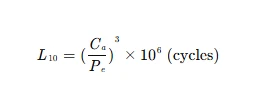
ISO 281 defines the rated lifespan formula as:
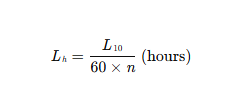
Or converted into units of time:
In the following locations:
Ca:Basic dynamic load class (N) determined by manufacturer through accelerated lifespan tests;
Pe: Equivalent dynamic load (N) reflecting composite load under actual operating conditions;
n: Rotational speed (r/min);
L10:90% reliability rated lifetime (cycle);
Lh: Rated lifespan (hours).
2.2 Calculation Method (Pe Equivalent Dynamic Load
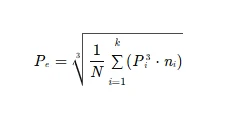
Under actual operating conditions, the load will change periodically. Weighted average method is needed to calculate equivalent dynamic loads:
In the following locations:
- Pi:i-th class load (N);
- ni:Duration: Proportion of i-th load (%);
- N: Total number of cycles.
For example, a ball screw in a CNC machine tool is subjected to a load of three levels during processing:
- Empty (P1 = 100 N, or 30%);
- Cutting (P2 = 500 N, 60%%);
- Fast crossing (P3 = 200 N, 10%).
The equivalent dynamic load is calculated as follows:

2.3 Application of Correction Factors
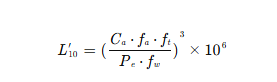
In order to improve the accuracy of the calculation, the following correction factors need to be introduced:
- Load factor: reflects the impact of shock and vibration on lifespan. Range from 1.0 to 1.2 for smooth operation, 1.2 to 1.5 for moderate impact and 1.5 to 3.0 for strong impact.
- Hardness factor (fa): compensates for the deviation of hardness of the material. When the actual hardness is below standard, the rated load needs to be reduced.
- Temperature factor (ft): High temperatures reduce the strength of the material. For example, when operating temperatures exceed 100°C, fts can drop below 0.5 ° C.
The revised lifespan formula is:
3. Lifespan Optimization Strategies under Continuous Operation Conditions
3.1 Refined Modeling of Load Spectra
Under continuous working conditions, the accuracy of load spectra directly influences the life prediction results. The following methods are recommended:
- Measurement method: using sensor to collect actual load data and establish time load curve;
- Simulation method: the finite element method is used to simulate the motion of mechanical system and to extract the dynamic load on ball screw.
- Statistical Methods: Analyze historical data of similar equipment and establish the empirical load model.
The load spectrum of wind turbine ball screw is double-peak distribution, and the peak occurs when the wind speed suddenly changes. By optimizing pitch control algorithm, the load fluctuation range reduced by 30% and the lifespan was increased to 1.8 times the original design.
3.2 Dynamic management of Lubrication Conditions.
The lubrication state can affect the service life of ball screws several times. Under continuous operating conditions, it is recommended that:
- Selection of Select lubrication methods: for high-speed applications, oil-air lubrication; for low speed, heavy load applications, suitable for grease lubrication;
- Optimize lubrication cycles temperature sensors are used to monitor the raceway temperature, triggering replenishment of oil when the temperature increases by more than 15°C;
- Matching lubricant: Select viscosity grades according to ambient temperature. For example, working operating temperatures VG46 lubricating oil range from -20°C to 80°C.
Experiments show that in a dusty environment, using a sealed ball screw and lubricating it regularly can extend its service life to 2.5 times that of an unsealed structure.
3.3 Preloaded intelligent controls;
Excessive preload increase frictional heat, while insufficient preload cause clearance vibration. Under continuous operating conditions, it is recommended that:
- Set initial preload: select 5% -10% of the rated dynamic load;
- Establishment of dynamic adjustment mechanism: using piezoelectric sensors monitor the preload loss and automatically tighten when the loss exceeds 15%;
- Set fault warning thresholds: Trigger maintenance alarms when preload loss reaches 30%.
The downtime caused by the pre-tensioning failure was reduced by 70% after the intelligent pre-tensioning system was used on the ball screw of the automobile production line.
4. Engineering Case: Improvement of the Lifespan of Ball Screws in continuous rolling mill
The metal mill ball screw was originally designed to last 8,000 hours, but fatigue spalling occurred after only 3,000 hours of operation. The useful life has been extended to 15,000 hours through the following improvements:
1.Load optimization:
Original design: Equivalent dynamic load Pe = 12 kN;
Improved: Pe was reduced to 9.5 kN. by optimizing roll speed matching.
2.Lubrication upgrade:
Original solution: Manual grease lubrication, 48 hours circulation;
Improved: Automatic oil and gas lubrication, fuel supply rate 0.2 mL/min.
3.Material improvements:
Original material: GCr15 bearing steel, hardness HRC 58-62;
Improved: a carburizing and quenching process, surface hardness increased to HRC 62-65, core toughness increased by 20%.
4.Structural optimization:
Increase the number of balls: from 30 to 45, with an 18% reduction in contact pressure
Optimized lead angle: Adjusted from 9° to 7°, increasing axial stiffness by 15%.
V. Future directions of technology
Digital twin technology: by establishing virtual model of ball screw, the physical state of ball screw can be drawn in real time, and dynamic life can be predicted.
Self-healing material: Development of coating material with self-healing ability of micro-crack to prolong fatigue lifespan;
Magnetic levitation technology: Explore contactless transmission solutions to completely eliminate rolling fatigue failure modes.
6. Conclusion:
ball screws life calculation is an interdisciplinary materials science, tribology and systems engineering. Under the condition of continuous operation, life can be maximized by load spectrum modeling, lubrication management and preload control. With the development of Internet of Things (IoT) and intelligence technologies, ball screws life prediction is moving from static computing to dynamic optimization, providing critical support for intelligent manufacturing in the Age of Industry 4.0.


