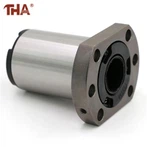
As a very important transmission component in the mechanical industry, linear guide rail has a wide range of applications, especially in automation equipment, and we can basically see its role. In the process of using the linear guide rail, in order to ensure the normal operation of the linear guide rail, an appropriate gap should be maintained between the sliding surfaces of the linear guide rail. If the clearance is too small, the friction will increase, and if the clearance is too large, the guiding accuracy will decrease.
Normally, if the clearance of the linear guide rail is too large, we will generally adopt two methods: inlay and pressing plate.

1. The insert strip is used to adjust the side clearance between the rectangular linear guide rail and the dovetail linear guide rail to ensure the normal contact of the surface of the linear guide rail. Inserts should be placed on the side of the linear guide rail with less stress, and there are two commonly used types: flat inserts and wedge inserts. The flat strip is easy to adjust and manufacture, but the strip is thin, and only a few points are in stress contact with the screw rod, which is easy to deform and has low stiffness.
Adjustment method 1: adjustment screw is used to drive the panel to move longitudinally to adjust the gap. Simply put, it is adjusted from both ends with five screws to avoid the panel moving, which has better performance.
Adjustment method 2: adjust the insert through the screw and nut, insert the scraper into the round hole and finish machining. This method is convenient to adjust and can prevent the panel from moving, but the longitudinal dimension is slightly longer.

2. The pressure plate is used to adjust the surface clearance of the auxiliary linear guide rail and bear the overturning moment.
Adjustment method 1: adjust the gap by grinding or scraping the surface. The surface of the pressure plate is separated by empty grooves. If the gap is too large or too small, it will be ground or scraped off. This method is simple in structure and widely used, but it is difficult to adjust. It is usually suitable for occasions where the adjustment is not frequent, the linear guide rail has good wear resistance or the clearance has little influence on the accuracy.
Adjustment method 2: adjust by changing the thickness of the spacer between the pressure plate and the connecting surface. The gasket is made of many thin copper sheets stacked together and welded to one side with tin. This method is more convenient than scraping the pressure plate, but the adjustment is limited by the thickness of the gasket, which reduces the contact stiffness of the joint surface.
Whatsapp/wechat:17769815516/ 18157863895
Email:admin@gyballscrew.com
gykristyliu@gmail.com
judith@gyballscrew.com