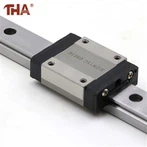
Generally speaking, once the mechanical parts are assembled, the errors of each part will accumulate, and most examples result in a decrease in accuracy after assembly. However, in linear guides using steel balls, there are some types of products that absorb the error of the mounting surface due to the elastic deformation of the steel balls, or depending on the contact structure between the steel balls and the steel ball rolling grooves, the errors will not accumulate, but are smaller than the original error. Improving the accuracy of the mounting surface excessively without understanding this situation will increase the overall manufacturing cost.
When comparing the allowable error of a standard guide rail width of 25mm and the 2-axis parallelism of an ordinary gap product without preload, the radial type "SR25" is 50μm, the four-direction equal-load type "HSR25" is 30μm, and the allowable error of the upper and lower rails When comparing with the standard rail width of 25mm, "SR25" is 200μm and "HSR25" is 130μm, which is a very large allowable value. Linear guides with large allowable values can meet the requirements without increasing the accuracy of the mounting surface too high. Therefore, the machining cost is reduced, and the assembly and alignment operations are simple, thereby reducing the processing and assembly man-hours. As a result, a device with a more competitive overall price can be manufactured.
The larger the model, the larger the allowable error. Regardless of the load and life selection point of view or the point of view of the installation surface to absorb the amount of error, it is important to choose a larger model rail. However, it should be noted that this allowable value will vary with the manufacturer of the linear guide when selecting it. Exceeding the allowable value will soon end the service life.
Contact Us
E-mail: sales@gyballscrew.com Tel(WhatsApp): 17769816967
seller@gyballscrew.com 17769815516
saleChen@gyballscrew.com 15325179771