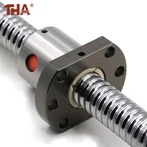
Unexplained backlash during axis reversal, positioning drift over long machining cycles, and unexpected motor torque spikes usually get blamed on a worn ball nut. In reality, most linear drive inaccuracies trace back to loose fixed-end bearing locknuts, thermal elongation of the screw shaft under continuous duty, or mismatched preload selection. When a ball screw assembly operates without rigid axial restraint or proper lubrication, small reversing gaps multiply into major pitch errors on the finished workpiece.
Matching the nut configuration and end-support setup to operational speed is essential for drive stiffness. Standard SFU single-nut ball screws utilize a gothic arch groove and oversized steel balls to eliminate axial play for general C7 rolled automation. For CNC milling machine axes demanding high reversing accuracy, DFU double-nut assemblies insert precision shims between two nuts, creating a push-pull preload that eliminates backlash under heavy alternating loads. For high-speed runs where traditional return tubes make too much noise, SFS nuts switch to internal end-cap caps to smooth out ball circulation. On the mounting side, lock down axial movement with angular contact bearings inside BK or FK fixed blocks, then use simple BF or FF floating blocks on the far end so the screw can expand freely as it warms up.
Getting high repeat accuracy means aligning your motor mount, bearing blocks, and guide rails dead-center during assembly. Mount the BK fixed support housing first, tighten its locknut against the shoulder, and align the ball screw shaft concentric with the guide rails using a dial indicator across the full stroke. For long-stroke high-speed axes, apply a calculated pre-stretch during fixed-end mounting to compensate for thermal elongation caused by friction heat. Always supply ISO VG 68 slide oil or Lithium EP2 grease through the nut grease port; running dry recirculating steel balls leads to rapid ball cage wear, micro-spalling along the raceway, and complete loss of drive preload.
Field Integration FAQ
When should you upgrade from an SFU single nut to a DFU double nut ball screw assembly?
Upgrade to a DFU double nut assembly whenever an axis faces alternating heavy cutting forces or requires zero axial play under load reversals. While an SFU nut relies on ball sizing for light preloading, a DFU double nut physically forces two nuts against an internal shim, maintaining consistent drive stiffness and zero backlash even as components experience slight operational wear.
What is the proper method to install BK fixed support housings and BF floating support housings?
Lock the screw shaft firmly into the BK fixed support unit using its precision locknut and duplex angular contact bearings to absorb all axial thrust forces. At the opposite end, install the BF floating housing with a deep-groove ball bearing that floats inside its bore on a snap ring. This allows the screw shaft to expand or contract longitudinally as friction heat builds up, preventing the shaft from bowing or binding during long runs.
What causes sudden positioning drift and thermal elongation in a CNC ball screw axis?
Thermal drift happens when continuous rotation generates friction heat within the ball nut and end bearings, causing the steel shaft to expand linearly. Locking down the floating end (BF or FF) instead of letting it slide axially forces the expanding steel shaft to bow sideways. That misalignment adds heavy radial drag, bakes the drive motor, and ruins pitch accuracy over time.
Technical Performance Matrix
| Parameter | Engineering Specification |
| Screw & Nut Material | GCr15 / SUJ2 High-Carbon Chromium Bearing Steel |
| Hardness & Surface | Induction Hardened HRC 58–62, Ground / Rolled Finish |
| Screw Manufacturing Grades | C7 Rolled (0.050 mm / 300 mm), C5 Ground (0.018 mm / 300 mm), C3 Ground |
| Nut Types & Configurations | SFU (Single Nut Flange), DFU (Double Nut Flange Preload), SFS (High-Speed Silent End-Cap) |
| Support Unit Models | BK / FK (Fixed End with Angular Contact Bearings), BF / FF (Floating End) |
| Preload Level Options | P0 (Standard Clearance), P1 (Light Preload), P2 (Heavy Preload) |
Keeping a precision ball screw drive accurate over millions of cycles relies on solid axial locking at the fixed end, letting the tail end breathe as it heats up, and keeping the recirculating ball tracks well-lubricated.