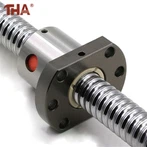
At present, large roller screw rods generally use medium frequent induction quenching. In production, the screws treated (ignition) often occur. After the grinding thread and magnetic detection detection, a shaft appears on the arc of the threaded track. It or mesh cracks, and even use the naked eye when grinding the thread, causing scrap of the screw. This not only caused direct economic losses to the enterprise, but also caused by many reasons for the problem, which brought a lot of pressure on the company's production -line operators.
On the basis of long -term research on the research of screw heat treatment technology, through the failure analysis and tracking process of a large number of large screw cracks, it summarizes multiple reasons and control measures that cause large screw cracks, and verification through batch production.
Analysis of the cause
First, the quality of raw materials is poor.
The super -worsefire tissue of the CCR15 material (including sheet -like pearl) is a carbonized mesh -like super -mortal tissue tissue. Based on the absent and micro -tissue analysis of the crack screw carbide, about 40%of the unqualified screw rods are always the perpetcia or ballized annealing tissue of mesh -shaped carbonized dumps.
During the inductive quenching process, due to the unevenness of the carbide, the surface of the screw is unevenly distributed and the internal stress distribution is generated, resulting in internal stress concentration of carbides. When grinding the scarf, the internal stress of the grinding site exceeds the yield strength of the material, which generates grinding cracks. The existence of thin slices of pearls causes the surface of the screw rod to be thick and large after quenching, which reduces the yield strength of the steel, and the internal stress of the screw rod is greater than the yield strength of the material, thereby generating grinding cracks.
Second, the heat treatment of mid -frequency scarf quenching.
The high quenching temperature or insufficient recovery is its main manifestation. After analysis, statistics, etc., the grinding cracks caused by the screws account for about 20%-30%of the total.
During the frequency quenching of the large roller screw, the mid -frequency output power is high, and the cooling speed of the drying in the dry internal fire work will be too slow, which will make the temperature high when the screws quench. High, the horsesta tissue level is high (level 5) after the screw -quenching, or even exceeds the highest level (Matrier 5). The martensite tissue in the grinding screws is thicker, which reduces the toughness of the steel. The internal stress caused by the grinding process is greater than the yield stress of the steel to produce cracks.
During the quenching process, the internal stress (including thermal stress and tissue transformation stress) of the large roller screw rod is large, insufficient the ignition (low humidity or short recovery time). Clear.
After the quenching recovers, the internal stress inside the screw rod is superimposed with the grinding stress generated by the grinding. When the stress of the superposition is greater than the yield strength of the steel, the surface of the screw rod will produce cracks.