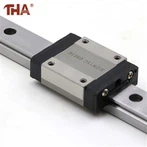
As an indispensable part of modern machinery and automation equipment, linear guide rail is widely used in CNC machine tools, robots, automatic production lines and other fields. Its role is to provide smooth linear guidance, reduce friction, and ensure accurate positioning. Although linear guides play such an important role in precision machinery, their performance and stability are often severely tested in the face of a variety of complex working situations.

The "complexity" of the working condition is often reflected in high load, vibration, pollution, temperature fluctuations and other factors. It is not difficult to imagine that a linear guide rail works in an environment of heavy load, impact, temperature difference changes or dust pollution, requiring it not only to carry a large amount of mechanical gravity, but also to be able to continue and smoothly complete the guiding task. For designers and engineers, how to maintain the accuracy and stability of linear guides under such demanding conditions is a big challenge they must face.
In some high load or frequent impact conditions, linear guides not only need to withstand huge mechanical gravity, but also maintain high precision linear motion on this basis. This requires that the material of the guide rail must have sufficient strength and rigidity. In order to meet this challenge, many linear guides in high-load environments use high-strength alloy steel materials, which can maintain stability under heavy loads and effectively reduce precision deviations due to wear and deformation.
In some extreme working environments, especially when faced with high or low temperature challenges, the performance of the guide rail is often significantly affected. Under high temperature conditions, the thermal expansion of metal materials cannot be ignored, which may lead to a significant reduction in the accuracy of the guide rail. At the same time, the lubricating oil will also accelerate its aging process due to excessive temperature, which seriously weakens its lubrication efficiency. In order to effectively cope with this special condition, many linear guides used in high temperature environments will especially choose materials with excellent high temperature resistance.
In many industrial environments, especially those that require exposure to chemicals, moisture or dust, linear guides are vulnerable to external contaminants. These pollutants may not only lead to increased surface wear of the guide rail, but also may accelerate the failure of the guide rail due to corrosion. Therefore, the tightness of the guide rail becomes particularly important. In order to prevent dust and dirt from entering, many linear guides use double or multiple sealing structures, sealing strips and dust caps can effectively isolate external pollutants.
High-speed motion or high-frequency vibration is another common complex condition. The movement of high speed or frequent vibration often leads to small displacement of the guide rail, which affects the smoothness and accuracy of the movement. In this case, the vibration resistance and dynamic performance of the linear guide are particularly important. In order to deal with this problem, many high-precision linear guide designs will add shock absorption elements, or improve its vibration resistance by optimizing the structure of the guide rail.
The lubrication system plays a crucial role in the long-term operation of the linear guide rail, especially under the conditions of large loads or more extreme working environments. Traditional methods of lubrication often rely on manual refueling or regular maintenance, however, this method can not fully adapt to the high efficiency and precision requirements of automated production lines.
The adaptability of linear guide is not only determined by its material and processing accuracy, but also closely related to the control of the environment and the application of intelligent technology. By selecting the right materials, strengthening the seal and protection design, optimizing the lubrication system and introducing intelligent technology, linear guides can maintain good performance and stability in a variety of complex working conditions. With the continuous progress of industrial technology, the design and manufacturing technology of linear guide rail is also constantly innovative, and the future linear guide rail will be more intelligent, reliable, and able to cope with more stringent working conditions.

Whatsapp/wechat:17769815516/18967093658
Email: admin@gyballscrew.com
gykristyliu@gmail.com
sales@gyballscrew.com