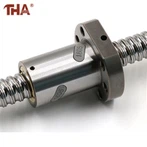
As a key component in modern mechanical equipment, linear guides are widely used in various fields such as precision machinery, automation equipment, and CNC machine tools. They bear the heavy responsibility of supporting and guiding moving parts to ensure that the equipment can run smoothly and accurately. However, in practical applications, linear guides often have noise problems, which not only affects the performance of the equipment, but also reduces the user experience. Therefore, in-depth exploration of the causes and solutions to linear guide noise problems is of great significance for improving equipment reliability and operating efficiency.
Common causes of noise in linear guides
There are many reasons for linear guide noise, mainly including poor lubrication, guide wear, improper installation, and uneven load.
1. Poor lubrication effect: Due to insufficient, deteriorated or improper selection of lubricating oil or grease, coupled with blockage or failure of the lubrication system, the friction of the guide rail may increase during movement, thereby generating noise.
2. Guide rail wear problem: Long-term use may cause wear on the guide rail surface, and uneven wear or excessive wear may increase the vibration and noise of the guide rail. In addition, long-term operation will also cause the guide rail to deform, twist or even break. In addition, the fatigue and aging of the guide rail material are also one of the key factors in noise generation.
3. Improper installation method: If the installation accuracy of the guide rail is not enough, the gap between the base or other parts is too large, and the installation is loose or unstable, the guide rail may shake or vibrate when moving, thereby generating noise.
4. Uneven load: Too large or too small load will cause the guide rail to be subjected to uneven force. At the same time, the uneven distribution of load will also aggravate the local wear of the guide rail. These factors may cause vibration and noise during the movement of the guide rail. In addition, the vibration and noise of the guide rail may also be caused by the change of dynamic load.
How to determine the specific source of linear guide noise
The specific source of linear guide noise can be determined by auscultation, observation and instrument detection.
1. Auscultation method: Use a stethoscope or put your ear close to the guide rail to carefully observe the characteristics and source of the noise. Under normal circumstances, sound is transmitted by the human ear. If the noise emitted by the guide rail exceeds a certain range, it should be suspected that the motor is faulty. Although this method seems simple, it requires us to have an in-depth understanding and experience of the noise properties of the guide rail.
2. Observation method: Check whether there is wear, scratches or foreign matter on the surface of the guide rail, and whether the movement of the guide rail is stable, vibrating or shaking. Use a micrometer to measure the gap between the slider and the guide rail, and record its changes. After careful observation, we can preliminarily evaluate whether the guide rail is worn, loose or improperly installed.
3. In terms of instrument detection, we use special detection equipment such as vibration measuring instruments and noise meters to evaluate the vibration and noise conditions of the guide rail. By analyzing the factors that affect the vibration and noise, the cause of the noise is determined and corresponding solutions are proposed. This technology can obtain the vibration and noise data of the guide rail more accurately, thus providing scientific support for determining the source of the noise.
How to solve the linear guide noise caused by poor lubrication
For the linear guide noise problem caused by poor lubrication, the following measures can be taken to solve it:
1. Relubrication: Lubricating oil or grease should be checked and replenished regularly to ensure that the lubricating oil meets the predetermined standards in quality and quantity. Under normal circumstances, the surface of the guide rail should be kept clean and flat. When selecting lubricating oil, we must ensure that it matches the material and movement environment of the guide rail.
2. Replace lubricating oil: Lubricating oil that has deteriorated or aged should be replaced regularly, and ensure that expired or substandard lubricating oil is not used.
3. The main task of cleaning the lubrication system is to remove various impurities and stains in the lubrication system to ensure the smooth operation of the lubrication system. Install one or more cleaning components on the guide rail, which can remove sediment and oil stains on the surface of the guide rail and allow the lubricating oil to flow into the bearing through them. Doing so helps to reduce the friction and vibration generated by the guide rail during movement, thereby effectively reducing the noise level.
How to deal with the noise problem caused by guide rail wear
For the noise problem caused by guide rail wear, the following measures can be taken to deal with it:
1. Replace worn rails: Replace rails with high wear to ensure that the new rails meet the predetermined standards in terms of accuracy and performance. If uneven wear or local cracks are found, lubricant can be applied to the surface and the worn and failed parts can be polished off in time. This is the most intuitive and efficient means to solve the noise problem caused by wear of the rails.
2. Repair the surface of the rails: Repair or polish the surface of the lightly worn rails to restore the smoothness and accuracy of the rail surface. This method can keep the rails straight during operation and ensure that they have sufficiently high wear resistance without damaging other components. This helps to reduce the friction and vibration generated by the rails during movement, thereby effectively reducing the noise level.
3. Adjust the clearance of the rails: Adjust the matching clearance between the rails and other components according to the wear condition to ensure that the rails remain stable and vibration-free during movement. Reduce the sliding speed while ensuring that the rails are not deformed to reduce the friction heat generated by excessive friction. This helps to further reduce the noise generated by the rails.
How to adjust and solve the noise caused by improper installation or uneven load
For the noise problem of linear guides caused by improper installation or uneven load, the following measures can be taken to adjust and solve it:
1. Reset the guide rail: Ensure that the installation accuracy of the guide rail meets the predetermined standard, and adjust the matching gap between the guide rail and the base or other components. Ensure that the guide rail maintains the correct position and size during the assembly process, so that it is in the best working condition and avoids loosening due to wear of the guide rail. This helps to solve the problems of instability and vibration of the guide rail caused by improper installation.
2. Strengthen the stability of the guide rail: Strengthen those loose or unstable guide rails to ensure that they will not shake or shift when moving. This method can be achieved by removing the nuts originally installed on the guide rail, re-tightening them, and then installing them. This helps to further enhance the stability of the guide rail and reduce noise.
3. Optimize the load distribution: Adjust the size and distribution of the load to ensure that the force on the guide rail is uniform. In order to avoid vibration and noise problems caused by changes in dynamic loads on the guide rail. Using different load distribution schemes during machine tool processing can effectively improve the processing efficiency and accuracy of machine tools. To achieve this goal, we can improve the design of the equipment and adjust its load mode.
Conclusion
In general, there are many reasons why linear guides generate noise, including insufficient lubrication, wear of the guides, improper installation and uneven load. In the actual production process, due to the influence of various factors, the linear guides generate some noise, which may cause safety accidents in serious cases. In the face of these challenges, we have the ability to implement a series of strategies to deal with and adjust. On this basis, we must also note that the use environment of linear guides is very harsh, and their surfaces are easily scratched or abraded by various mechanical impacts, which is extremely unfavorable to the service life of linear guides. Through periodic inspection, lubrication, adjustment and replacement and other maintenance measures, we can significantly reduce the noise level of linear guides, thereby improving the reliability and operation efficiency of the equipment. In the future, we need to continue to increase the research and experimental analysis of the mechanism of linear guide noise generation, and further optimize the existing linear guide structure to make it more suitable for actual production. At the same time, we also need to strengthen quality management and technological innovation during the design and production process of the equipment to fundamentally avoid the problem of noise generated by linear guides.